Outsource Photo Editing to a US Studio — Full Retouch, Not Just a Cutout
You didn't become a photographer to spend Sunday night on skin retouch. But here you are — the wedding gallery due Wednesday, the product shoot backlog on the second monitor, and the sinking realization that your editing queue has become your business's actual bottleneck. Outsourcing photo editing sounds like the answer until you look at what's actually on offer: offshore shops that cut out the background and send it back to you flat, uncorrected, half the color wrong. So it lands back on your desk anyway.
We're the alternative. A US studio doing full manual retouch — the entire finish, not the first step of it. And because our clients' work is confidential, we won't show you someone else's catalog on this page. Send us your hardest batch and judge us on your own.
Send Us a Test BatchWhat ~$0.25/image actually delivers, vs. what "outsource photo editing" should mean
The offshore commodity market has trained an entire industry to think outsourcing photo editing means paying someone in another time zone to remove backgrounds. That's not editing. That's the first ten seconds of editing. Here's the difference, side by side.
| Offshore background removal (~$0.25/image market rate) | Full US product retouch (what we deliver) | |
|---|---|---|
| What's included | Background removed, silhouette cut out on white | Background + color + fabric + shadow + skin + catalog consistency |
| Color accuracy | Whatever the camera captured — no product-matched correction | Corrected against the actual product |
| Fabric and texture | Often smoothed or lost in the cutout process | Preserved through the retouch — cotton reads as cotton |
| Shadows and reflections | Removed with the background, or replaced with a generic drop shadow | Retouched or rebuilt to match the product and the light |
| Skin (on-model work) | Not typically included in the deliverable | Manually retouched, pores and texture kept |
| Batch consistency | Depends on which operator, which day | Held to one standard by a single team through internal QC |
| Corrections cycle | Returns to your desk for cleanup | Caught in our QC before delivery |
| Standard turnaround | 24–48 hours typical | ~1 business day |
That's not a claim that offshore shops do a bad job at what they do. It's that what they do isn't the same job. When a photographer says "I need my editing outsourced," they usually mean the whole edit — the finish, not the first cut. Get sold the first cut, and you become the finish yourself. (For a standalone background isolation job on its own, that's our clipping path service.)
What "full product retouch" actually includes
Every claim above is specific. Here's what each one means in practice.
Color correction against the actual product.
The garment's real color, not what the camera saw under the lighting on the day. Corrected against physical reference where you send one, or against your brand's established color standards once you've worked with us before.
Fabric and texture preservation.
Weave, sheen, drape, and material character kept intact through every retouch pass. A cotton twill still reads as cotton twill. A knit still reads as a knit. We don't smooth material into a flat surface.
Shadow, reflection, and light continuity.
Shadows either retained from the source or rebuilt to match the product and the light. Reflections on glass, metal, or lacquer treated with the same care as the product itself. No generic drop shadows tacked on.
Skin retouch that still reads as skin.
For on-model work, manual retouch that removes distractions without erasing the pores, the texture, or the light structure that make a person look like a person.
Background handling — however you need it.
Cutout on pure white for storefront pages. Kept in situ for editorial. Replaced with a brand color or a new environment for campaign work. All handled to your specification, not ours — including standalone clipping path work when that's all a batch needs.
Catalog-wide consistency.
When a product ships across a fifty-image catalog or an eight-colorway run, the retouch treatment stays the same across every image. Same color logic, same shadow handling, same finish — the same discipline behind our apparel catalog retouching. That consistency is what separates a catalog reading as one shoot from a set of files that visibly came from different desks.
Who this page is for
Working photographers with an editing backlog you can't finish yourself.
Weddings, portraits, product shoots, editorial — the work is booked, the shoots are happening, and post has become the bottleneck that decides whether next month is possible. You need a partner you can trust with your name attached to the output, not a shop that will make you the QC department for whatever comes back.
Small studios scaling past what your in-house post team can absorb.
You already have retouchers, but not enough of them, and adding heads for a seasonal spike isn't the answer. What you need is a US-managed extension of your existing team — one that respects your house style rather than imposing a generic one.
Ecommerce brands who tried the ~$0.25/image route and became the QC department for their own catalog.
Cheap on paper, expensive in the hours your team spent checking, flagging, and re-briefing. You're not shopping for the cheapest per-image rate anymore — you're shopping for the standard you can point to next quarter without checking every file yourself, the same reason brands come to us for e-commerce photo editing.
How outsourcing photo editing actually works with us
1. Start with a test batch.
Send us a small sample of your actual work — the shots that are hardest, not the easiest. We retouch it to the standard we would deliver at volume, so what you're judging is real work, not a demo.
2. Onboarding, with your standards captured on the way in.
Once the test lands and you decide to work with us, we set up your account. Your file specs, your color standards, your crop conventions, your naming rules — all captured at onboarding, so we're not asking you the same setup questions on order three.
3. One coordinator per account.
This is the operational answer to the "which offshore operator got my images this week?" problem. Your coordinator holds the working knowledge of your brand and your workflow, and the same person carries it through every project. By the third order, we're not asking. We're applying.
4. Every batch through the same three-stage workflow.
Preparation, retouch by a specialist in that category, and internal QC before delivery. Nothing ships on a single person's say-so. This is what keeps the fiftieth image in a batch to the same standard as the first.
5. Turnaround planned against your program.
Standard batches — roughly 500 images or fewer, depending on retouch depth — typically return in one business day. Larger orders and editorial or high-touch work are scoped and quoted per project so the timeline is committed at quote, not guessed at.
6. Brand standards that accumulate over time.
Every time we finish a project for you, what we learned stays on the account. Retouch depth, color biases, shadow preferences, the things you flagged — all recorded on the account, not held in one operator's head. That's why consistency with us gets better the longer you work with us, not worse.
7. The practical piece.
File transfer through our client portal, over SFTP, or by pulling directly from your servers — whichever fits your existing workflow, including web-optimized image delivery when that's what your pipeline needs. Coordination handled from our US studio and Paris office.
Why you can trust us with your work
Every image we work on is under NDA. We sign our clients' NDAs at onboarding, and their work stays confidential — which is why you won't find their catalogs on this page. Discretion is the studio's default position. A studio that would show off theirs would show off yours.
What we can show you is the studio itself. Here's what backs the work.
A studio, not a marketplace.
We've been operating since 2013. Across that time we've processed more than 3 million images. Our team is 30+ professional retouchers organized by category specialty — apparel, product, on-model, editorial — so the work goes to the person who does that kind of work every day, not to whoever is free that hour.
Operational specifics you can verify.
The single coordinator. The ~1 business day standard turnaround. The three-stage internal QC. Encrypted transfer and encrypted storage. We sign your NDA at onboarding. These aren't aspirational — they're how the work moves through the studio every day.
The two examples below.
Our team's work. Two pieces rather than twenty, chosen because you can judge them without being a retoucher. They show you what the standard means; the test batch shows you whether we hit it on your work.
Quality defined concretely, not with buzzwords.
When we say "color-true," we mean corrected against the actual product, not what the camera captured. When we say "consistent," we mean the fiftieth image in a batch meets the same standard as the first. When we say "natural," we mean the fabric still reads as fabric and the skin still reads as skin. Each of those is defined above under "what full product retouch actually includes" — not left as adjectives you have to take our word for.
Two examples of the standard
Two pieces, showing two different things. The first is about consistency across a range — one product, four colorways, held to a single standard. The second is a single correction, close enough to see what changed. Consistency needs a set to be visible; a correction needs a comparison. So the first is shown as a set and the second as a pair.
Both were picked because you can judge them without being a retoucher. Colors change. A garment starts hanging properly. The craft that only another retoucher would notice — shadow gradients, edge handling at the background boundary — is on every image we deliver, but it doesn't make an argument on a web page. These two do.
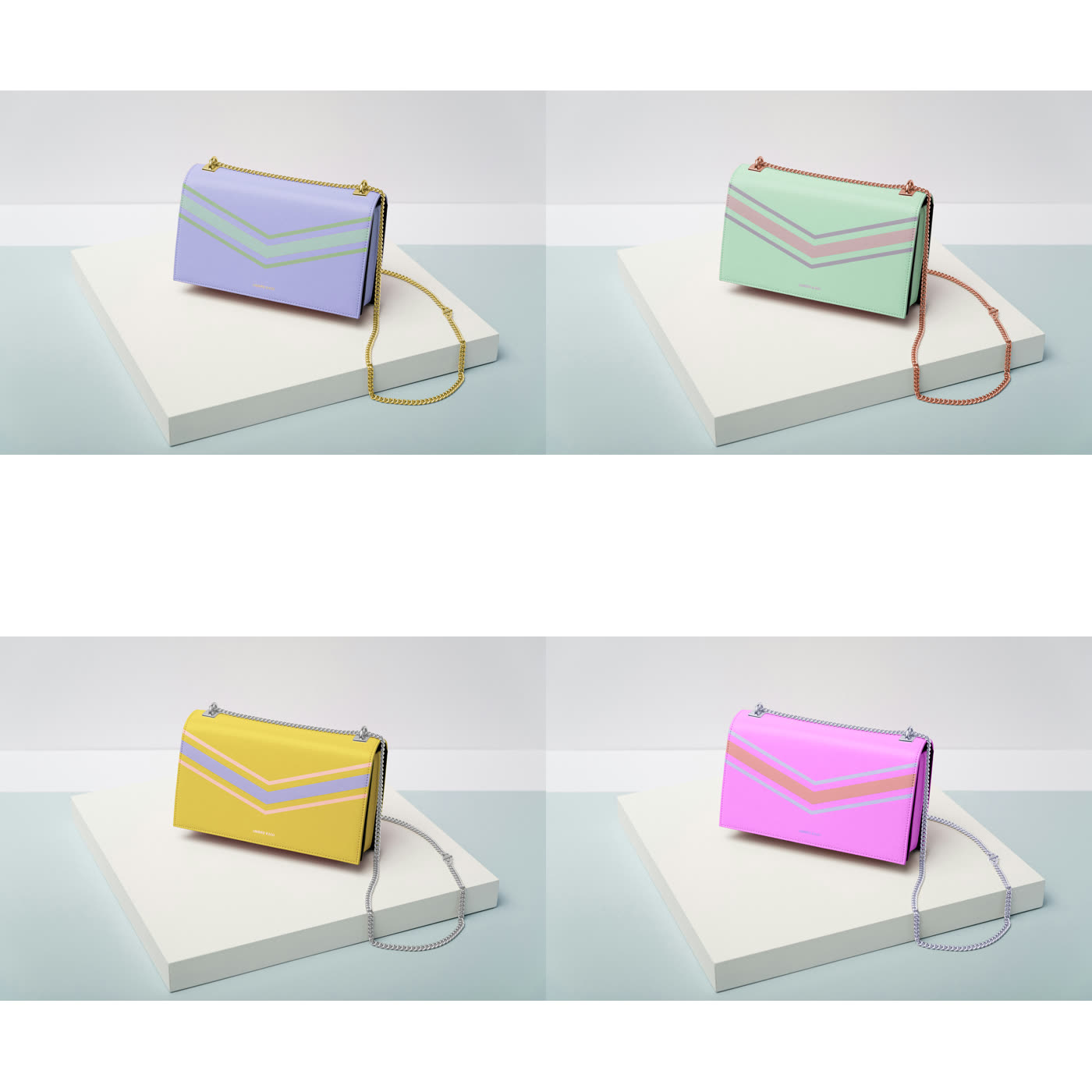
One product, four colorways, one standard.
The same garment finished across four colors. Same crop, same shadow logic, same finish on all four. When a product ships in multiple colorways, this is what "consistent" has to mean — not each image good on its own, but all of them belonging to the same catalog.
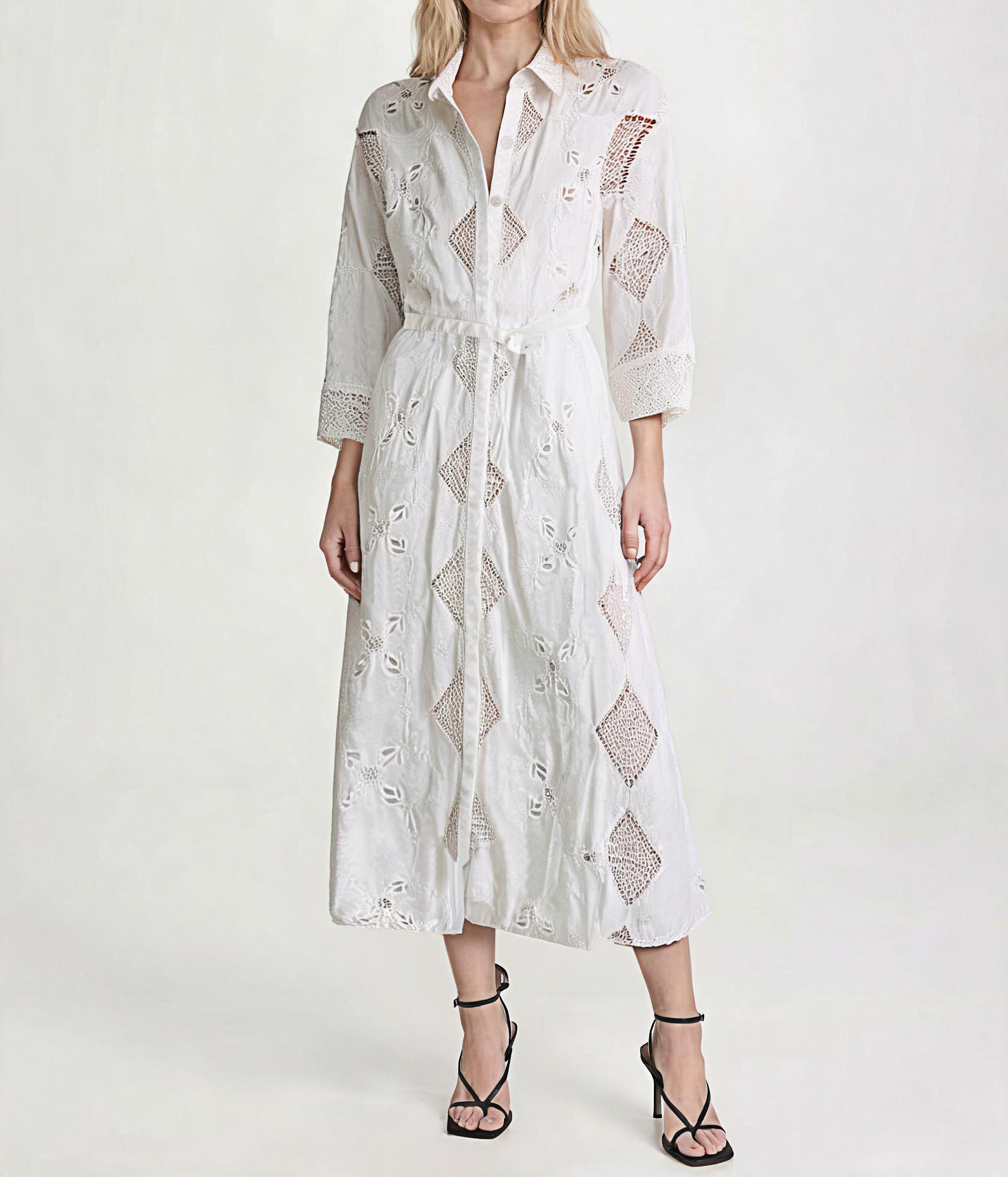
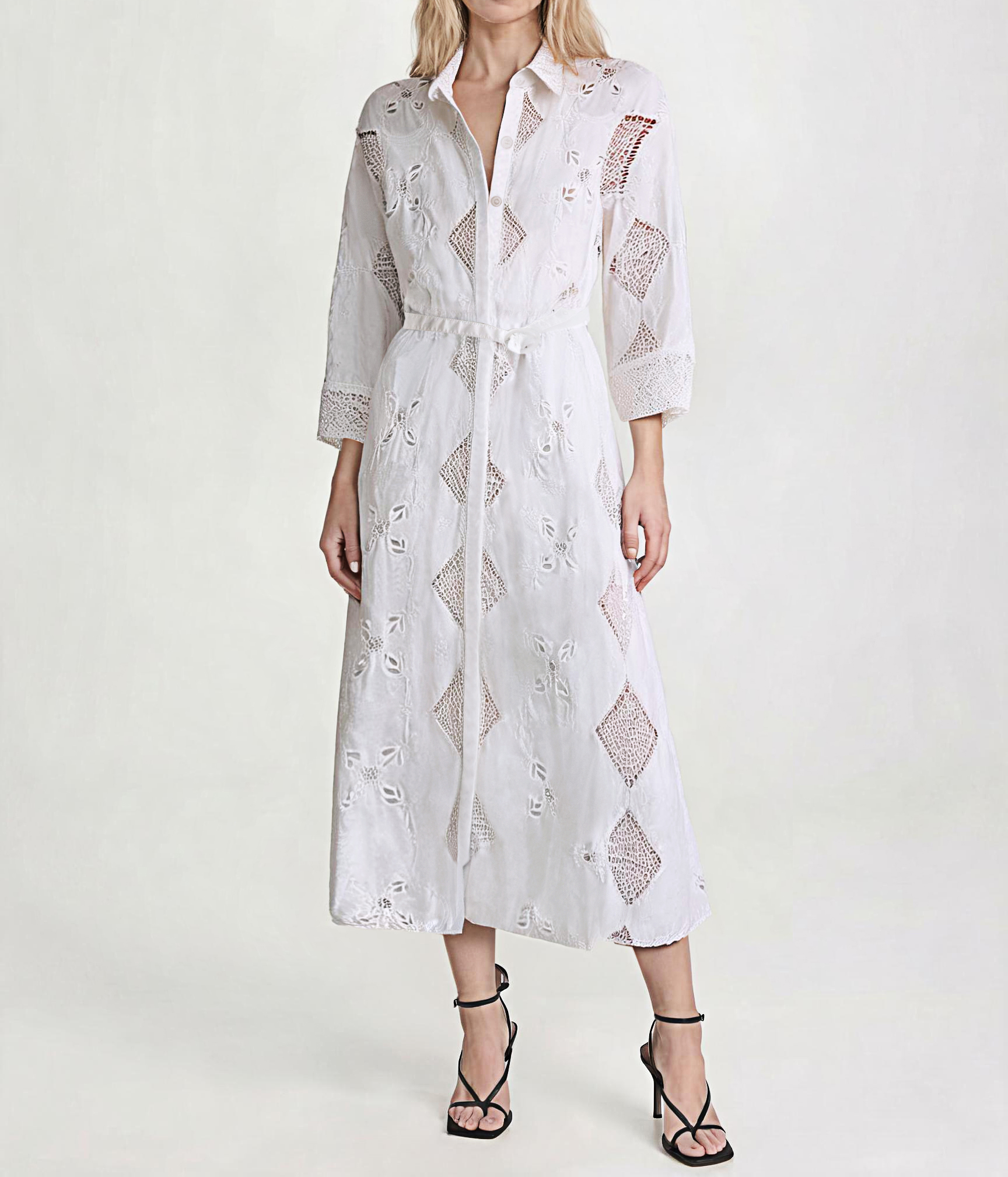
Drape corrected, fabric intact.
The retouch: creases smoothed, drape and silhouette corrected so the garment hangs the way it was cut — and the eyelet embroidery, crochet panels, and lace cuffs all still there at full detail. That last part is the whole point. Shape correction is where retouching most often goes wrong: push it far enough to fix the fall of a garment and open weaves are usually the first thing to close up, leaving a silhouette that looks right and a fabric that looks like plastic. Every hole in the eyelet survived.
The rest of the argument is the test batch. These two show you what we mean; your own images show you whether we deliver it.
What we cost
We don't publish a per-image rate. Full product retouch isn't a per-cutout commodity — the quote depends on your volume, your cadence, the retouch depth your images actually need, and whether you're a one-off project or a recurring program. Tell us what you shoot and we'll scope it. The quote comes back with the working structure and the turnaround, not just a number.
Frequently asked questions
How fast is your turnaround?
Standard batches — roughly 500 images or fewer, depending on retouch depth — typically return in one business day. Larger or higher-touch orders are scoped and quoted per project so the timeline is committed at quote, not guessed at.
How do I send you my files, and is it secure?
Three options: our client portal, SFTP, or we pull directly from your server. Transfer is encrypted. Storage is encrypted. Pick whichever already fits your workflow — we adapt to yours, not the other way around.
Do you sign NDAs?
Yes. We sign our clients' NDAs at onboarding — we don't push our own paper. Your work is confidential; we don't assert ourselves over that.
Is there a minimum order?
No meaningful minimum. A photographer with occasional overflow can send a small batch. Studios and brands running ongoing programs are where the operational advantages — accumulating brand standards, capacity planning, single-coordinator continuity — earn out most, but there's no batch-size floor to work with us.
How does the test batch work?
Send us a small batch of your actual work — the shots that are hardest, not the easiest. We retouch it to the standard we'd deliver at volume, and you judge the output on real work rather than on a promise. No charge, no obligation.
Do you retouch on-model / people photography as well as product?
Yes. Skin retouch, hair cleanup, garment fit and drape correction, and the full on-model workflow are handled by retouchers who do on-model work daily — separate specialists from the product-only team. If your work mixes both — a model wearing a garment for a lookbook, for example — we quote the whole shoot as one project.
Send us your hardest batch
We can't show you our clients' work — it's under NDA and we take that seriously. So the way to actually judge a US studio doing full manual retouch isn't a marketing page. It's your own images, retouched to the standard we'd deliver at volume, back on your desk in a working day. No charge, no obligation. Send us the shots you can't get right on the first pass — the ones with the tricky light, the color your camera lost, the fabric that flattens under an offshore cutout. We'll retouch a small batch. You'll see the finish on work you actually have to ship.
Send Us a Test Batch